
• Blog
  • >
  • Can Accutane Cause Acne Scars or Prevent Them

Can Accutane Cause Acne Scars or Prevent Them

We hope this blog post is helpful, for dermatology care from DermOnDemand, click here.

Can Accutane cause acne scars? Learn what research shows, how scars form, and what isotretinoin can and cannot change in your skin.

Dr. Ross Atkins

March 19, 2026  ⁃  13 Min read

Accutane does not cause acne scars and is commonly used to help prevent them by controlling severe acne and reducing inflammation. In fact, limiting deep acne lesions, it lowers the chance of long-term skin damage that leads to scarring.

When people ask, “Can Accutane cause acne scars?” the confusion usually stems from changes in skin texture during treatment that make existing scars more noticeable. The medication can make the skin dry and more sensitive, which may highlight uneven areas but does not create new scars.

 Overall, its primary role is to treat acne early and reduce the risk of future scarring, not to worsen it.

Key Takeaways

  • Accutane does not cause acne scars; it helps treat severe acne and reduces the risk of new scars by controlling inflammation and breakouts.
  • Scars often seem more visible during treatment because dry skin and reduced oil make existing texture and uneven areas easier to see.
  • Acne scars form from deep inflammation and collagen damage, not from the medication itself, which is why early acne control is important.
  • Accutane does not remove existing scars, so procedures like laser treatments, microneedling, or chemical peeling are often needed after treatment.
  • Most acne scars cannot be completely removed, but targeted treatments can improve their appearance and create more even skin over time.

Does Accutane Cause Acne Scars

Short Answer Based on Evidence

The short answer is no. Isotretinoin is used to treat severe acne, especially deep nodules and cysts that are more likely to leave permanent marks, and its main value is that fewer active breakouts usually mean fewer future scars. 

The AAD (American Academy of Dermatology) describes isotretinoin as a treatment for severe acne and notes that clearing severe acne can reduce the risk of later scarring.

That does not mean every person sees smoother skin while taking it. A patient may still notice texture, pits, or raised areas that were already forming before treatment started. When that happens, the timing can make it feel as if the medication caused the scars, even when the deeper skin injury came from the acne itself.

Why This Question Is Common

This question is common because isotretinoin is often started after acne has been severe for an extended period. By that point, the skin may have undergone repeated cycles of inflammation, rupture, and healing, which is exactly the process that creates scars.

 The NHS also notes that isotretinoin is generally reserved for severe acne, including acne at risk of scarring, so many people begin treatment after damage has already begun.

There is also a visual reason for the confusion. As inflamed bumps flatten and the skin becomes drier, the eye stops focusing on red breakouts and starts noticing shallow dents, uneven texture, or lingering discoloration. 

That shift in what stands out on the face is one reason people keep asking, Are acne scars caused by Accutane?

Why Accutane May Seem to Cause Scars

Skin Changes During Treatment

Isotretinoin reduces oil production very effectively. That is a major reason it works, because less oil means fewer blocked follicles and less fuel for new inflammation, but it also means many patients develop dry skin, chapped lips, and surface peeling during treatment. 

Those effects are common enough that both AAD and NHS guidance discuss skin dryness and irritation as expected side effects.

Dryness changes the way skin looks. When the skin barrier is less hydrated, fine textural changes reflect light more sharply, so shallow depressions and uneven edges can look more obvious than they did when acne was active, and the skin was oilier. 

In other words, the medication may reveal preexisting texture rather than create new structural damage.

Why Acne Scars Look Worse on Accutane

People often search for phrases like “acne scars look worse on Accutane” because that experience feels real.

 The skin can look tighter, more matte, and less forgiving, which makes pits and contour changes easier to notice in daylight or in photos. Severe acne may also stop dominating the face at the same time, so scars become the new focal point.

This is the key distinction behind the question, How does Accutane cause acne scars? The answer is that it usually does not cause them in a direct biological sense, but it can change the skin environment enough for old scars to become more visible. That difference between “causing” and “making easier to see” matters for both medical accuracy and patient expectations.

How Accutane Affects Acne and Skin

Oil Reduction and Inflammation

What Accutane is and how it works helps explain why isotretinoin works on several parts of acne at once. It shrinks sebaceous glands, reduces sebum, lowers inflammation, and helps reduce the conditions that lead to acne lesions. This is why it is often used when other therapies do not control deep, scarring acne well enough.

That mechanism matters because scars usually follow inflammation, not just clogged pores. When acne remains deep and inflamed, collagen in the skin can break down or heal unevenly. Reducing that inflammatory burden early is one of the main ways isotretinoin can help prevent further acne scarring.

Increased Skin Sensitivity

The same drug that helps control severe acne can also make skin more fragile in the short term. Patients often become more sensitive to the sun, harsh cleansers, and aggressive exfoliation, which is why skin care guidance during treatment usually focuses on simple cleansing, moisturizer, and sun protection. 

Those surface changes can affect comfort and appearance even when the medication is helping with deeper acne.

This is also why scar care is not just about the medication itself. A patient who over-scrubs, picks, or uses irritating products while the skin is fragile can add redness and delay recovery. Good support care during isotretinoin is not cosmetic extra care; it is part of protecting the skin while the medicine does its job.

Why Acne Scars Form

Inflammation and Collagen Damage

Acne scars form when the skin is injured deeply enough that normal repair does not restore its original structure. When a cyst or nodule ruptures and the inflammation extends into the dermis, the body has to rebuild tissue, and that repair may leave a depression or a raised scar. AAD explains that deeper breakouts are more likely to scar, and picking or scratching can also increase damage.

The repair process depends heavily on collagen. If the skin loses too much collagen during inflammation, it can heal with sunken scars. If the body produces too much collagen during the repair phase, it can form raised scars, such as hypertrophic scars.

Types of Acne Scars
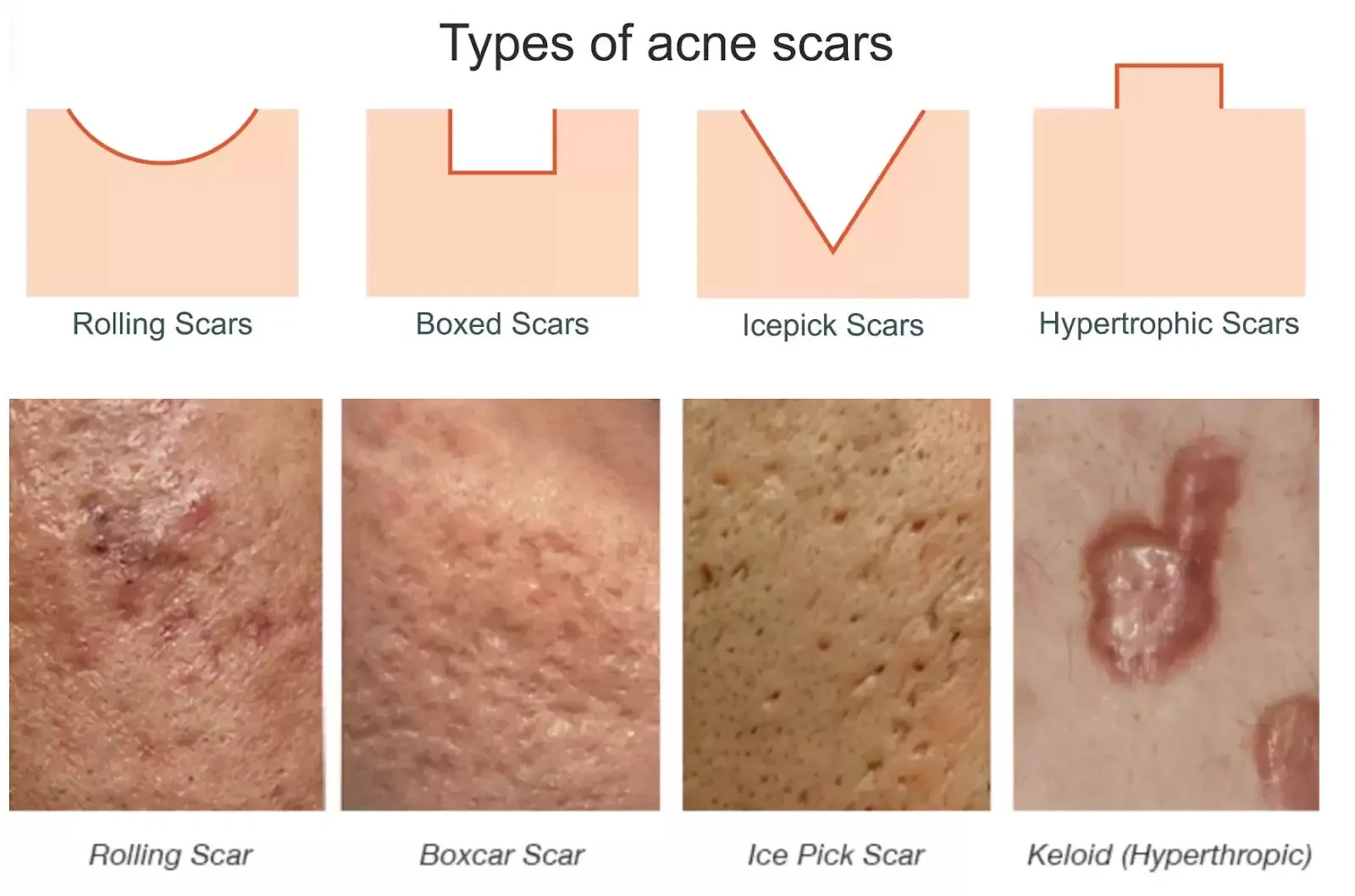
There are several types of acne scars, and grouping them correctly matters because treatment varies by type. Depressed scars, also called atrophic acne scars, include ice-pick, boxcar, and rolling patterns, while raised scars include hypertrophic scars and keloid-like changes in some patients. 

AAD’s acne scar guidance separates depressed scars from raised scars for the same reason, because they respond to different treatments.

Patients also confuse scars with discoloration. Flat red or brown marks left after acne are common, but they are not always true scars, as the skin surface may still be level. That distinction helps explain why some marks fade with time, while deeper pits and raised scars usually need targeted treatment.

Does Accutane Improve or Remove Acne Scars

What It May Improve

Isotretinoin can indirectly improve overall skin appearance. When active acne settles, redness, swelling, and new lesions decrease, so the face can look calmer and more even.

 Some people also notice that very shallow textural changes look a bit better after the full course because the skin is no longer under constant inflammatory stress.

That indirect improvement is not the same as scar removal, and whether Accutane helps with scarring is a useful question when setting realistic expectations. Even when studies suggest some modest scar benefit in selected cases, the drug is still being prescribed to control acne first, not as a primary scar procedure. 

The more accurate message is that isotretinoin may help prevent new scar formation, but it does not reliably remodel established pits or raised scars on its own.

What It Cannot Treat

Isotretinoin does not directly rebuild lost tissue in depressed scars. It also does not flatten raised scars predictably, nor does it replace procedures used to reshape scarred skin. 

AAD notes that acne scar treatment often requires procedures, scar surgery, or medication applied to the skin, and treatment may differ based on whether scars are depressed or raised.

It is also important to separate scars from active acne care. A person may finish treatment with clear skin but still have indentations, surface tethering, or thickened scar areas. That outcome does not mean the medication failed; it means acne control and scar correction are related but separate goals.

Accutane Scars Before and After Expectations


Realistic Results Over Time

“Before and after” searches usually mix several questions. People want to know whether acne will clear, whether marks will fade, whether pits will lift, and how long any improvement will take. 

AAD states that a course of isotretinoin generally lasts about 4 to 6 months, though treatment can be shorter or longer depending on the dose and response.

Over those months of treatment, what improves most clearly is active acne. Scars may look better in some photos because the skin is no longer inflamed or swollen, but established contour changes often require their own treatment plan once the acne has stabilized. 

That is why Accutane before and after scars images can be hard to interpret without knowing whether someone also had later procedures.

Factors That Affect Outcomes

Several factors shape what a patient sees at the end of treatment. These include how long the acne was active, how deep the lesions were, whether picking occurred, the person’s own healing pattern, and which scar type is present. Deeper nodules and cysts are more likely to leave scars, so the starting point matters a lot.

Skin care habits also matter. A patient who protects the barrier, avoids picking, and follows treatment instructions gives the skin a better chance to heal without additional surface irritation. That does not erase scar biology, but it can make the difference between a calmer recovery and a more inflamed one.

Best Treatment for Acne Scars After Accutane

In-Office Dermatology Procedures

Once acne is controlled, the next question is usually about the best treatment for acne scars after Accutane. The answer depends on scar type, skin tone, downtime tolerance, and how aggressive the correction plan needs to be. 

AAD lists several office-based approaches for acne scars, including microneedling, scar surgery, fillers for some depressed scars, and other procedures chosen by scar pattern.

Procedures often work by triggering controlled repair in the skin. Microneedling can help increase collagen and elastin, which may soften some depressed scars over time, while some laser treatments target texture and remodeling more directly.

 Depending on the pattern, a dermatologist may also discuss subcision, focal scar surgery, or a combined approach rather than a single isolated treatment.

At-Home Care Options

Home care matters, but it should be viewed as support care rather than a complete scar solution. Some topical medications can help post-inflammatory marks or support a smoother texture over time, especially once the skin has recovered enough to tolerate them. 

These products can be useful, but they do not usually replace procedures for deep scars. Simple measures still matter a great deal. 

Gentle cleansing, sunscreen, and a moisturizer that supports the barrier can reduce ongoing irritation and help the skin recover more evenly. At the appropriate time, a clinician may also consider chemical peeling or other staged treatments, but timing should be individualized, as skin can remain sensitive after isotretinoin.

Can You Fully Remove Acne Scars

What 100 Percent Removal Means

Many readers ask whether scars can be removed completely. AAD’s acne scar overview says scars can fade, but they rarely go away completely on their own, and treatment is generally about making them less noticeable rather than restoring untouched skin. 

That framing is important because it keeps the goal realistic and medically honest.

“100 percent removal” is also not one single standard. One patient may mean no visible pits in bathroom lighting, while another may mean no detectable texture at very close range. Scar treatment usually aims for meaningful improvement in texture, depth, color, and blending, not perfect erasure.

Limits of Current Treatments

Current treatment can help many patients, but results vary. Deep ice-pick scars, rolling scars tied down by fibrous bands, and thick raised scars all behave differently, so even excellent care often requires staged treatment. That is why acne scar care is usually described as a process rather than a quick fix.

A patient should also know that a particular treatment may improve one problem while leaving another unresolved. For example, surface roughness may soften before bigger tethering changes do, or color may improve before depth does. Good planning depends on first identifying which part of the scar pattern matters most.

Why Is Accutane Banned in Japan

Regulation and Safety Monitoring

This search question comes up often because people use it as a shorthand way to ask if the drug is unsafe. The better explanation is that drug approval and prescribing rules vary by country, and isotretinoin is tightly regulated because it requires careful patient selection, counseling, and monitoring.

 In places where it is prescribed, patients are usually followed closely because the medication has meaningful risks, even though it can be very effective.

Those safety issues are real, but they do not prove that isotretinoin causes acne scars. Common side effects include dryness and irritation, and serious monitoring concerns include preventing pregnancy and monitoring for certain warning symptoms. 

AAD notes that inflammatory bowel disease has been debated in relation to isotretinoin, but the evidence is not strong enough to prove causation, while NHS guidance lists IBD as a condition that needs caution or may affect suitability.

When to See a Dermatologist

Signs of Scarring

A patient should seek expert evaluation when acne is leaving dents, raised areas, or persistent textural changes, rather than only temporary color changes. That is especially important when breakouts are deep, recurrent, or emotionally distressing, because early control can reduce the amount of permanent damage that develops. 

AAD states that acne treatment aims not only to clear existing acne but also to prevent new breakouts and acne scars.

Useful warning signs include pits that remain after lesions heal, raised bands of scar tissue, and acne that keeps returning despite standard therapy.

 If scars are already forming, waiting too long can leave more tissue remodeling to manage later. In a setting such as DermOnDemand, the value of review is not promotion; it is simply matching the right stage of acne or scarring to the right level of care.

Planning Treatment After Accutane

Scar treatment planning after isotretinoin should be individualized. Some patients mainly need reassurance and time because post-acne marks will fade, while others need a true scar plan because the problem is structural. 

AAD advises patients to tell their dermatologist about acne treatments used in the 2 years before scar treatment, as timing can affect which procedures are appropriate.

The practical takeaway is simple. Isotretinoin helps stop the acne process that leads to scarring, but it does not remove existing scars. If you are still unsure how this applies to your skin, a medical evaluation can help clarify what active acne and scarring are, and which treatment options may be appropriate. 

Understanding your skin type and scar pattern allows for a more accurate plan and better long-term results.

 

References

Accutane does not cause acne scars and is commonly used to help prevent them by controlling severe acne and reducing inflammation. In fact, limiting deep acne lesions, it lowers the chance of long-term skin damage that leads to scarring.

When people ask, “Can Accutane cause acne scars?” the confusion usually stems from changes in skin texture during treatment that make existing scars more noticeable. The medication can make the skin dry and more sensitive, which may highlight uneven areas but does not create new scars.

 Overall, its primary role is to treat acne early and reduce the risk of future scarring, not to worsen it.

Key Takeaways

  • Accutane does not cause acne scars; it helps treat severe acne and reduces the risk of new scars by controlling inflammation and breakouts.
  • Scars often seem more visible during treatment because dry skin and reduced oil make existing texture and uneven areas easier to see.
  • Acne scars form from deep inflammation and collagen damage, not from the medication itself, which is why early acne control is important.
  • Accutane does not remove existing scars, so procedures like laser treatments, microneedling, or chemical peeling are often needed after treatment.
  • Most acne scars cannot be completely removed, but targeted treatments can improve their appearance and create more even skin over time.


Does Accutane Cause Acne Scars

Short Answer Based on Evidence

The short answer is no. Isotretinoin is used to treat severe acne, especially deep nodules and cysts that are more likely to leave permanent marks, and its main value is that fewer active breakouts usually mean fewer future scars. 

The AAD (American Academy of Dermatology) describes isotretinoin as a treatment for severe acne and notes that clearing severe acne can reduce the risk of later scarring.

That does not mean every person sees smoother skin while taking it. A patient may still notice texture, pits, or raised areas that were already forming before treatment started. When that happens, the timing can make it feel as if the medication caused the scars, even when the deeper skin injury came from the acne itself.

Why This Question Is Common

This question is common because isotretinoin is often started after acne has been severe for an extended period. By that point, the skin may have undergone repeated cycles of inflammation, rupture, and healing, which is exactly the process that creates scars.

 The NHS also notes that isotretinoin is generally reserved for severe acne, including acne at risk of scarring, so many people begin treatment after damage has already begun.

There is also a visual reason for the confusion. As inflamed bumps flatten and the skin becomes drier, the eye stops focusing on red breakouts and starts noticing shallow dents, uneven texture, or lingering discoloration. 

That shift in what stands out on the face is one reason people keep asking, Are acne scars caused by Accutane?

Why Accutane May Seem to Cause Scars

Skin Changes During Treatment

Isotretinoin reduces oil production very effectively. That is a major reason it works, because less oil means fewer blocked follicles and less fuel for new inflammation, but it also means many patients develop dry skin, chapped lips, and surface peeling during treatment. 

Those effects are common enough that both AAD and NHS guidance discuss skin dryness and irritation as expected side effects.

Dryness changes the way skin looks. When the skin barrier is less hydrated, fine textural changes reflect light more sharply, so shallow depressions and uneven edges can look more obvious than they did when acne was active, and the skin was oilier. 

In other words, the medication may reveal preexisting texture rather than create new structural damage.

Why Acne Scars Look Worse on Accutane

People often search for phrases like “acne scars look worse on Accutane” because that experience feels real.

 The skin can look tighter, more matte, and less forgiving, which makes pits and contour changes easier to notice in daylight or in photos. Severe acne may also stop dominating the face at the same time, so scars become the new focal point.

This is the key distinction behind the question, How does Accutane cause acne scars? The answer is that it usually does not cause them in a direct biological sense, but it can change the skin environment enough for old scars to become more visible. That difference between “causing” and “making easier to see” matters for both medical accuracy and patient expectations.

How Accutane Affects Acne and Skin

Oil Reduction and Inflammation

What Accutane is and how it works helps explain why isotretinoin works on several parts of acne at once. It shrinks sebaceous glands, reduces sebum, lowers inflammation, and helps reduce the conditions that lead to acne lesions. This is why it is often used when other therapies do not control deep, scarring acne well enough.

That mechanism matters because scars usually follow inflammation, not just clogged pores. When acne remains deep and inflamed, collagen in the skin can break down or heal unevenly. Reducing that inflammatory burden early is one of the main ways isotretinoin can help prevent further acne scarring.

Increased Skin Sensitivity

The same drug that helps control severe acne can also make skin more fragile in the short term. Patients often become more sensitive to the sun, harsh cleansers, and aggressive exfoliation, which is why skin care guidance during treatment usually focuses on simple cleansing, moisturizer, and sun protection. 

Those surface changes can affect comfort and appearance even when the medication is helping with deeper acne.

This is also why scar care is not just about the medication itself. A patient who over-scrubs, picks, or uses irritating products while the skin is fragile can add redness and delay recovery. Good support care during isotretinoin is not cosmetic extra care; it is part of protecting the skin while the medicine does its job.

Why Acne Scars Form

Inflammation and Collagen Damage

Acne scars form when the skin is injured deeply enough that normal repair does not restore its original structure. When a cyst or nodule ruptures and the inflammation extends into the dermis, the body has to rebuild tissue, and that repair may leave a depression or a raised scar. AAD explains that deeper breakouts are more likely to scar, and picking or scratching can also increase damage.

The repair process depends heavily on collagen. If the skin loses too much collagen during inflammation, it can heal with sunken scars. If the body produces too much collagen during the repair phase, it can form raised scars, such as hypertrophic scars.

Types of Acne Scars

There are several types of acne scars, and grouping them correctly matters because treatment varies by type. Depressed scars, also called atrophic acne scars, include ice-pick, boxcar, and rolling patterns, while raised scars include hypertrophic scars and keloid-like changes in some patients. 

AAD’s acne scar guidance separates depressed scars from raised scars for the same reason, because they respond to different treatments.

Patients also confuse scars with discoloration. Flat red or brown marks left after acne are common, but they are not always true scars, as the skin surface may still be level. That distinction helps explain why some marks fade with time, while deeper pits and raised scars usually need targeted treatment.

Does Accutane Improve or Remove Acne Scars

What It May Improve

Isotretinoin can indirectly improve overall skin appearance. When active acne settles, redness, swelling, and new lesions decrease, so the face can look calmer and more even.

 Some people also notice that very shallow textural changes look a bit better after the full course because the skin is no longer under constant inflammatory stress.

That indirect improvement is not the same as scar removal, and whether Accutane helps with scarring is a useful question when setting realistic expectations. Even when studies suggest some modest scar benefit in selected cases, the drug is still being prescribed to control acne first, not as a primary scar procedure. 

The more accurate message is that isotretinoin may help prevent new scar formation, but it does not reliably remodel established pits or raised scars on its own.

What It Cannot Treat

Isotretinoin does not directly rebuild lost tissue in depressed scars. It also does not flatten raised scars predictably, nor does it replace procedures used to reshape scarred skin. 

AAD notes that acne scar treatment often requires procedures, scar surgery, or medication applied to the skin, and treatment may differ based on whether scars are depressed or raised.

It is also important to separate scars from active acne care. A person may finish treatment with clear skin but still have indentations, surface tethering, or thickened scar areas. That outcome does not mean the medication failed; it means acne control and scar correction are related but separate goals.

Accutane Scars Before and After Expectations

Realistic Results Over Time

“Before and after” searches usually mix several questions. People want to know whether acne will clear, whether marks will fade, whether pits will lift, and how long any improvement will take. 

AAD states that a course of isotretinoin generally lasts about 4 to 6 months, though treatment can be shorter or longer depending on the dose and response.

Over those months of treatment, what improves most clearly is active acne. Scars may look better in some photos because the skin is no longer inflamed or swollen, but established contour changes often require their own treatment plan once the acne has stabilized. 

That is why Accutane before and after scars images can be hard to interpret without knowing whether someone also had later procedures.

Factors That Affect Outcomes

Several factors shape what a patient sees at the end of treatment. These include how long the acne was active, how deep the lesions were, whether picking occurred, the person’s own healing pattern, and which scar type is present. Deeper nodules and cysts are more likely to leave scars, so the starting point matters a lot.

Skin care habits also matter. A patient who protects the barrier, avoids picking, and follows treatment instructions gives the skin a better chance to heal without additional surface irritation. That does not erase scar biology, but it can make the difference between a calmer recovery and a more inflamed one.

Best Treatment for Acne Scars After Accutane

In-Office Dermatology Procedures

Once acne is controlled, the next question is usually about the best treatment for acne scars after Accutane. The answer depends on scar type, skin tone, downtime tolerance, and how aggressive the correction plan needs to be. 

AAD lists several office-based approaches for acne scars, including microneedling, scar surgery, fillers for some depressed scars, and other procedures chosen by scar pattern.

Procedures often work by triggering controlled repair in the skin. Microneedling can help increase collagen and elastin, which may soften some depressed scars over time, while some laser treatments target texture and remodeling more directly.

 Depending on the pattern, a dermatologist may also discuss subcision, focal scar surgery, or a combined approach rather than a single isolated treatment.

At-Home Care Options

Home care matters, but it should be viewed as support care rather than a complete scar solution. Some topical medications can help post-inflammatory marks or support a smoother texture over time, especially once the skin has recovered enough to tolerate them. 

These products can be useful, but they do not usually replace procedures for deep scars. Simple measures still matter a great deal. 

Gentle cleansing, sunscreen, and a moisturizer that supports the barrier can reduce ongoing irritation and help the skin recover more evenly. At the appropriate time, a clinician may also consider chemical peeling or other staged treatments, but timing should be individualized, as skin can remain sensitive after isotretinoin.

Can You Fully Remove Acne Scars

What 100 Percent Removal Means

Many readers ask whether scars can be removed completely. AAD’s acne scar overview says scars can fade, but they rarely go away completely on their own, and treatment is generally about making them less noticeable rather than restoring untouched skin. 

That framing is important because it keeps the goal realistic and medically honest.

“100 percent removal” is also not one single standard. One patient may mean no visible pits in bathroom lighting, while another may mean no detectable texture at very close range. Scar treatment usually aims for meaningful improvement in texture, depth, color, and blending, not perfect erasure.

Limits of Current Treatments

Current treatment can help many patients, but results vary. Deep ice-pick scars, rolling scars tied down by fibrous bands, and thick raised scars all behave differently, so even excellent care often requires staged treatment. That is why acne scar care is usually described as a process rather than a quick fix.

A patient should also know that a particular treatment may improve one problem while leaving another unresolved. For example, surface roughness may soften before bigger tethering changes do, or color may improve before depth does. Good planning depends on first identifying which part of the scar pattern matters most.

Why Is Accutane Banned in Japan

Regulation and Safety Monitoring

This search question comes up often because people use it as a shorthand way to ask if the drug is unsafe. The better explanation is that drug approval and prescribing rules vary by country, and isotretinoin is tightly regulated because it requires careful patient selection, counseling, and monitoring.

 In places where it is prescribed, patients are usually followed closely because the medication has meaningful risks, even though it can be very effective.

Those safety issues are real, but they do not prove that isotretinoin causes acne scars. Common side effects include dryness and irritation, and serious monitoring concerns include preventing pregnancy and monitoring for certain warning symptoms. 

AAD notes that inflammatory bowel disease has been debated in relation to isotretinoin, but the evidence is not strong enough to prove causation, while NHS guidance lists IBD as a condition that needs caution or may affect suitability.

When to See a Dermatologist

Signs of Scarring

A patient should seek expert evaluation when acne is leaving dents, raised areas, or persistent textural changes, rather than only temporary color changes. That is especially important when breakouts are deep, recurrent, or emotionally distressing, because early control can reduce the amount of permanent damage that develops. 

AAD states that acne treatment aims not only to clear existing acne but also to prevent new breakouts and acne scars.

Useful warning signs include pits that remain after lesions heal, raised bands of scar tissue, and acne that keeps returning despite standard therapy.

 If scars are already forming, waiting too long can leave more tissue remodeling to manage later. In a setting such as DermOnDemand, the value of review is not promotion; it is simply matching the right stage of acne or scarring to the right level of care.

Planning Treatment After Accutane

Scar treatment planning after isotretinoin should be individualized. Some patients mainly need reassurance and time because post-acne marks will fade, while others need a true scar plan because the problem is structural. 

AAD advises patients to tell their dermatologist about acne treatments used in the 2 years before scar treatment, as timing can affect which procedures are appropriate.

The practical takeaway is simple. Isotretinoin helps stop the acne process that leads to scarring, but it does not remove existing scars. If you are still unsure how this applies to your skin, a medical evaluation can help clarify what active acne and scarring are, and which treatment options may be appropriate. 

Understanding your skin type and scar pattern allows for a more accurate plan and better long-term results.


Get Dermatology Care